

Brian Gutekunst puts together paint-by-numbers draft marrying needs with perfect Packers fit
Green Bay, for better and for worse, has a type in the draft. And the board fell perfectly for the Packers to snag a truckload of them in the 2026 draft.

Good morning!
The Green Bay Packers put together one of the smallest draft classes in recent history, just six picks, but still managed to hit every glaring need, while adhering to their “types.” It was the thinnest of needles to thread, but Brian Gutekunst proved to be a master tailor.
Today’s edition of The Leap looks at a unique draft class that followed a combination of need, the consensus board, and the team’s preferred athletic models.
Thank you for reading and supporting our coverage. You can also support our work by following us on social media:
Jason B. Hirschhorn: @by_JBH on Twitter / @byjbh@bsky.social on Bluesky / @by_jbh on Threads
Peter Bukowski: @Peter_Bukowski on Twitter / @peterbukowski@bsky.social on Bluesky / @peter_bukowski on Threads
The Leap: @TheLeapGB on Twitter / @theleap.bsky.social on Bluesky / The Leap’s YouTube channel
If you appreciate thoughtful, independent coverage of the Packers and NFL, please consider becoming a paid subscriber. Your support allows us to serve this community with the stories and reporting it deserves.
As always, thanks for making The Leap a part of your day.
Rarely do the board and team needs align so cosmically. The Green Bay Packers picked off their needs one by one, in order of importance, in a rare blend of value and requirement. Brian Gutekunst filled crucial gaps in the roster with no-doubt Packers types, without having to shirk the wisdom of the consensus draft crowds. That’s not proof that the 2026 draft will yield a crop full of game-changing players, but the process was nearly unimpeachable.
He even managed to do it in order of importance, going cornerback, defensive tackle, pass rush, and interior offensive line depth before circling back to add at cornerback once again.
Oh, and he drafted a kicker, a position that cost the Packers a playoff game.
“He was one of those players that we didn’t see being available when we were picking at 52,” Gutekunst said Friday night after drafting South Carolina cornerback Brandon Cisse. Still, it was a sentiment that seemed to echo around seemingly every player the Packers drafted.
Gutekunst said the Pack considered picking third-round nose tackle Chris McClellan at 52, which is why the team traded up to 77 to get him. Penn State edge Dani Dennis-Sutton fell at 70 on the Wide Left consensus board, but the Packers got him at 120. Every team for nearly every pick says, “We didn’t think he’d be available to us,” or “He was the highest guy on our board.”
Most of the time, that’s just a thing teams say. Here, it was true based on the draft consensus. Packers executive Matt Malaspina said this, almost verbatim, about fifth-round pick Jager Burton as well.
In the draft, the Packers had the following picks
52
77
120
153
201
They got the following players ranked based on consensus
42
70
114
176
197
Now, we have to swap McClellan and DDS to make this work, but they netted out this way in the end, and the Packers desperately needed a nose tackle.
This is a good process. Not only that, they didn’t have to compromise their values on premium athletes. The last time the Packers had a need-heavy draft, in 2021, they drafted Josh Myers, who had no profile, and a small receiver with a mediocre athletic profile in Amari Rodgers. It didn’t work out.
Every position player the Packers took, who doesn’t play nose tackle, entered the draft with an RAS over 9. More on the nose tackle part later.
Cisse was such an obvious Packers type; he was one of the very first players we profiled on Locked on Packers for our Gutey’s Guys series. In that same series, I referred to Dennis-Sutton as “the most Packers-y defensive player in the draft.” And the only reason Jager Burton didn’t have a Gutey’s Guys profile (he was on the schedule for Friday afternoon) was that I caught a brutally timed cold and decided to save my voice for our Friday night live show.
“First of all, his production is really, really good. His size, his speed, and I just think he has so much in front of him as far as his best football goes. He's an elite athlete,” Gutekunst said of Dennis-Sutton, nearly the same thing that can be said about Cisse.
Gutekunst literally said almost the same thing about Cisse’s best football being in front of him, coming to the Packers not yet legally allowed to drink. The Packers GM quipped that the last time the team drafted a 20-year-old, Kenny Clark, it worked out pretty well.
Speaking of Clark, nose tackle is one of the few positions where athleticism has not been at the same premium. B.J. Raji had an RAS below four. Clarks checked in below eight. But McClellan notched six sacks last year, showing upside that other defensive tackles in this class simply didn’t have. For a team to justify a defensive tackle in the top-100, he has to be able to rush the passer.
“I think the combination of being able to play the nose, the three, and actually rush the passer — there's a lot of these guys that don't do that. He can,” Gutey said of McClellan.
Not everyone in the class is young, though. Burton will turn 24 in August, but checks every box for Packers types, from versatility to athleticism.
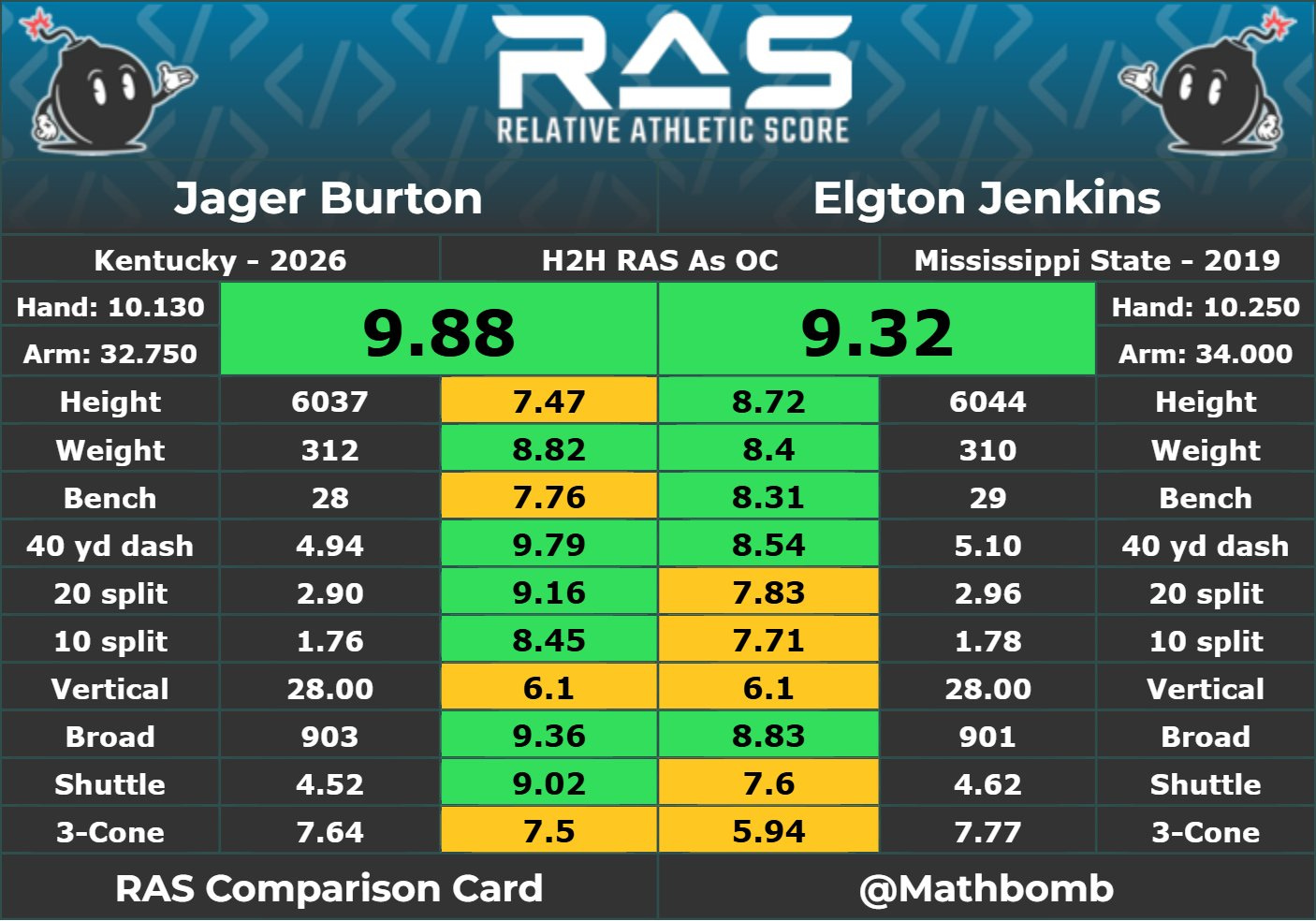
Burton played left guard, center, and right guard at Kentucky, and put together a very similar athletic profile to former Packers Pro Bowler Elgton Jenkins. Green Bay desperately needed depth along its offensive interior, and Burton could be the long-term answer at center if Sean Rhyan doesn’t live up to the contract the Packers gave him this offseason.
“I don't really have a preference (on where I play). Just whatever is going to help the Packers win games. At the end of the day, that's all I care about now,” Burton told local media following the selection.
Even sixth-round pick Domani Jackson comes to the Packers with elite athletic traits, a 6-foot cornerback with 4.4 speed who set records in high school for track. He went to USC as a five-star recruit, then transferred to Alabama, where he played the last two seasons. His 9.00 RAS was the worst of four position players drafted outside of McClellan.
Of course, hyper-athletic players aren’t assured to be great. Rashan Gary and Lukas Van Ness prove that point, though neither has been busts.
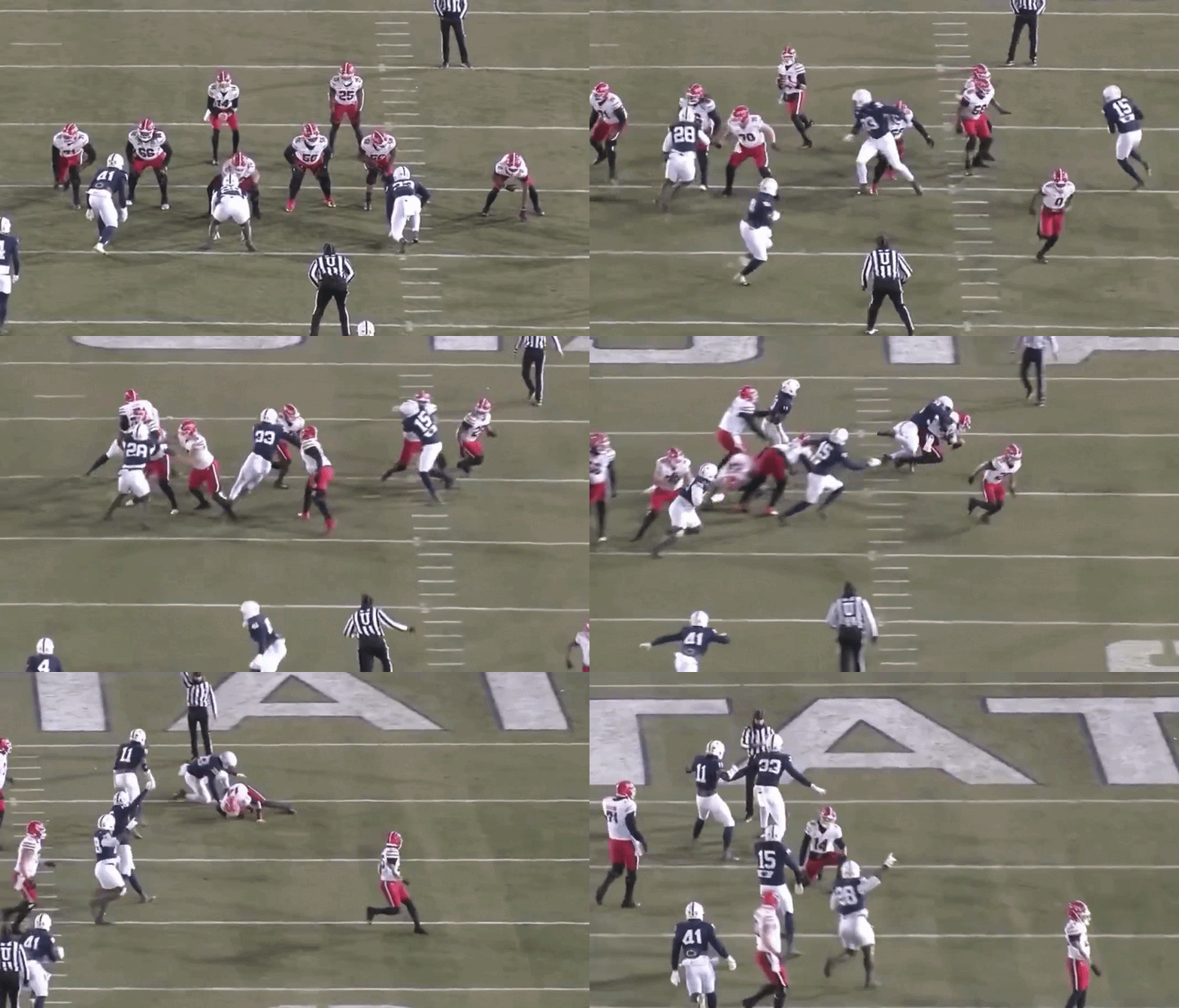
But veering closer to consensus mitigates risk, while adhering to a preference for elite athletes provides a path to upside. For example, DDS’s closest RAS comps are Danielle Hunter and Javon Kearse. He’s the only player in combine history to broad jump 10’11 and run a 6.9 or better 3-cone. The players even close to that vicinity are some of the best pass rushers of the last 15 years.
Contending teams are usually built through foundational drafts, a class that changes the paradigm for a franchise. It’s far too early to say the 2026 class will be that, but it’s easily the cleanest process the Packers have undertaken to date under Brian Gutekunst, whether that was intentional or the board simply happened to fall the right way.
The “why,” for the moment, is unimportant. It happened. Now it’s up to this class to perform. Over time, good processes lead to good outcomes.
We’ll see.