

Even if Tucker Kraft resets the tight end market, he will be a value as soon as the Packers sign him
Reports suggest Brian Gutekunst will make Tucker Kraft the highest-paid tight end in the NFL, but given the cost of other top pass-catchers, that won't break the bank.

Good morning!
The Green Bay Packers are one step closer to locking up their young pass-catching core long-term. First, Jayden Reed got a somewhat surprising extension, then the Packers paid Christian Watson a contract that left many NFL fans with sticker shock.
Tucker Kraft will be next, according to both recent reports and the words of Brian Gutekunst. But even if he gets paid at the top of the market, the way tight ends are valued in the NFL contract market, Green Bay will be getting a value.
Thank you for reading and supporting our coverage. You can also support our work by following us on social media:
Jason B. Hirschhorn: @by_JBH on Twitter / @byjbh@bsky.social on Bluesky / @by_jbh on Threads
Peter Bukowski: @Peter_Bukowski on Twitter / @peterbukowski@bsky.social on Bluesky / @peter_bukowski on Threads
The Leap: @TheLeapGB on Twitter / @theleap.bsky.social on Bluesky / The Leap's YouTube channel
If you appreciate thoughtful, independent coverage of the Packers and NFL, please consider becoming a paid subscriber. Your support allows us to serve this community with the stories and reporting it deserves.
As always, thanks for making The Leap a part of your day.
Does it make sense to pay Tucker Kraft at the top of the tight end market?
Peter Bukowski: Based on Kraft’s production last season and the trajectory it reflects, the answer is yes. But paying Jayden Reed and Christian Watson this offseason muddies the waters.
The Cincinnati Bengals will pay over $80 million for their pass catchers in 2026 and they’re fringe AFC contenders. Becoming a top-heavy team at any position can be precarious. Paying tight ends does not create that same problem.
In fact, Reed and Watson combined earn only slightly more than Ja’Marr Chase alone on their extensions. Meanwhile, Kraft will cost less than Tee Higgins.
Whether Reed and Watson are as valuable to the Packers as Chase is to the Bengals would draw reasonable disagreements, but Kraft’s value specifically, assuming his health, would not. The only objections would be from bad-faith actors or people who don’t understand math.
Green Bay had a better passing game by EPA/dropback last season than the Bengals did in 2024 when Chase won the Triple Crown. And that was without Kraft, Watson, and Reed for half a season each.
“I would consider Tucker Kraft a big-time priority for the Green Bay Packers,” Ian Rapaport recently reported on NFL Network.
“You’re talking about a guy who will probably reset the TE market.”
That seems scary, right? The top of the tight end market would only be $20 million in average annual salary. There are 22 receivers in the league making north of $20 million, and two who make double that figure.
There is no world in which Jaxon Smith-Njigba can be worth twice as much as Kraft.
Last season, Kraft led tight ends in yards per catch, yards after catch per reception, and Pro Football Focus grade. In fact, Kraft averaged more yards per catch for the Packers than JSN did for the Seattle Seahawks.
There’s a volume gap, to be sure. Kraft won’t see 163 targets in the Packers offense, but even accounting for that difference, Kraft averaged over 61 yards per game last year. That’s more than DeVonta Smith, Jaylen Waddle, DK Metcalf, Courtland Sutton, Davante Adams, and Tee Higgins, all of whom make more money than Kraft would even if he tops the market.
Paying Kraft like a middle-class WR2 provides incredible value for the Packers. And that’s before accounting for what Kraft brings as a blocker, his ability to create explosive plays without having to win one-on-one down the field, and everything the Packers do to create easy pitch-and-catch opportunities for him in high-leverage situations.
Sports Info Solutions created a metric called Total Points that attempts to account for the value generated by the player on his own. It’s a cousin of EPA in that it uses historical production data to assign value to things like drops, blown blocks, and value generated specific to the situation and place on the field.
Last year, Kraft finished 12th in Total Points among pass catchers, despite playing just eight games.
Annually, tight ends lead or are among leaders in this metric specifically because they provide considerably more value as blockers than receivers, and the best ones tend to generate important plays like third-down conversions and touchdowns, at a rate commensurate with the top receivers in the NFL.
They also tend to generate more of their own value because of where they’re getting the ball. Kraft is not the same vertical threat as someone like JSN, but if he gets the ball five yards from the line of scrimmage, he’s even more dangerous with the ball in his hands. There’s incredible value in taking a layup throw for a first down, even if it’s not a 50-yard touchdown.
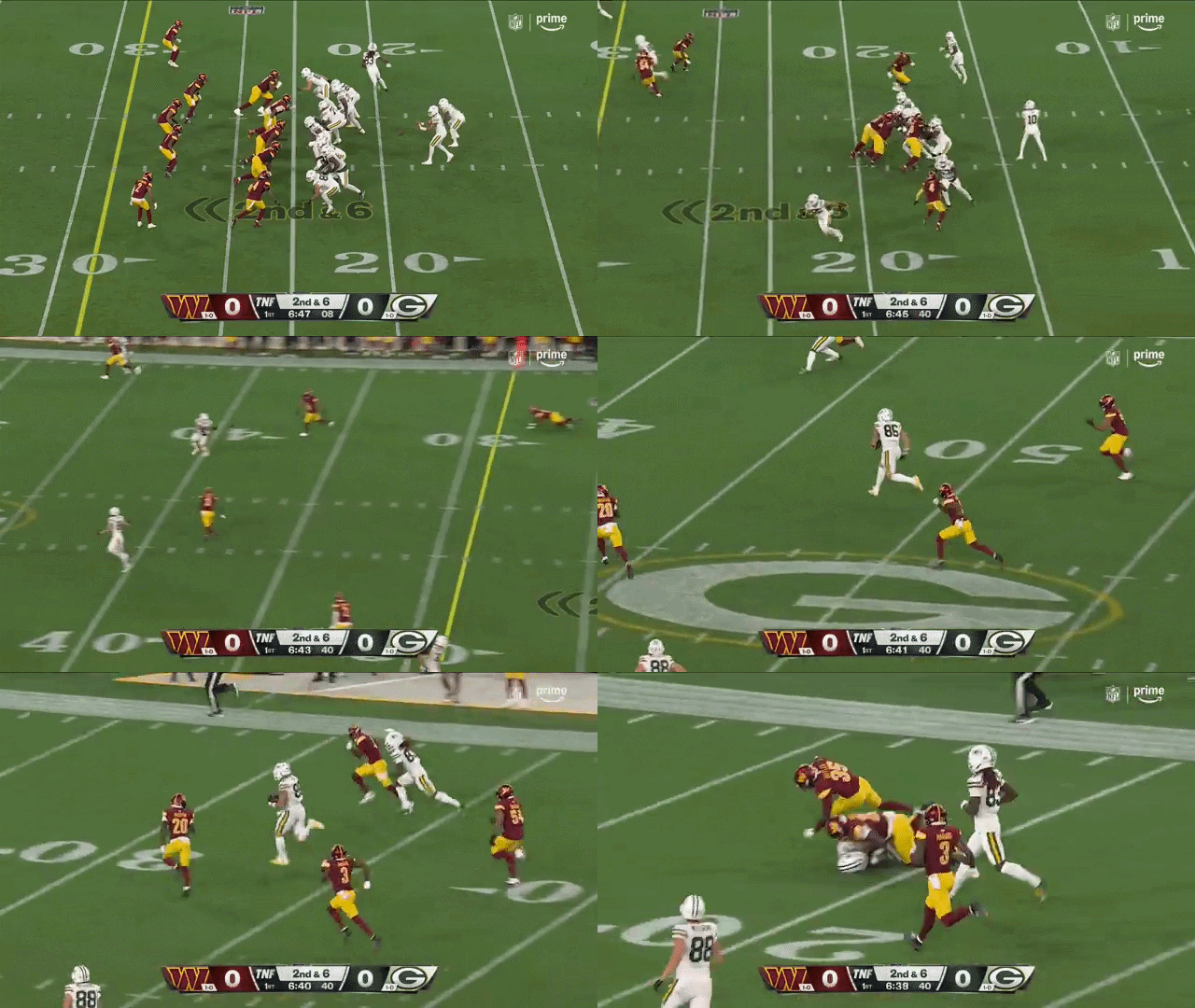
When the offense was struggling with the Cleveland Browns’ defense, it was a play-action dump off to a wide-open Kraft that he rumbled with to set up what should have been the game-winning field goal.
It’s nearly impossible to set up receivers so easily to generate those same opportunities.
Yet the tight end market has long reflected this inefficiency. Jimmy Graham’s insistence that he be franchise tagged as a receiver — because he basically was one and certainly provided value like one — came back in 2014, and the NFL still hasn’t caught up.
The Packers are slated to spend the 17th-most money on their offense in 2026. They were a top-five group last year by EPA/play. They’re getting luxury efficiency at Target prices. Even if they have to pay Kraft like the best tight end in football, if that’s what he is, or something close to it, he’s worth every penny and more.