

How did free agency net out for the Packers roster moving forward and what's left to do?
The Packers lost a handful of key starters from the 2025 team, but made some meaningful additions as well. Where do they stand right now?

Good morning!
The Green Bay Packers will be replacing starters at linebacker, offensive tackle, and receiver (at least), heading into 2026, and Brian Gutekunst also made some crucial moves to address positions of need that may or may not involve swapping starters.
Today’s edition of The Leap takes a look at the plan to replace outgoing players, what the new players bring, and where the roster stands at the moment.
Thank you for reading and supporting our coverage. You can also support our work by following us on social media:
Jason B. Hirschhorn: @by_JBH on Twitter / @byjbh@bsky.social on Bluesky / @by_jbh on Threads
Peter Bukowski: @Peter_Bukowski on Twitter / @peterbukowski@bsky.social on Bluesky / @peter_bukowski on Threads
The Leap: @TheLeapGB on Twitter / @theleap.bsky.social on Bluesky / The Leap's YouTube channel
If you appreciate thoughtful, independent coverage of the Packers and NFL, please consider becoming a paid subscriber. Your support allows us to serve this community with the stories and reporting it deserves.
As always, thanks for making The Leap a part of your day.
Outgoing starters (and a backup at a premium position) all have obvious replacements
Peter Bukowski: The Packers plan for these types of offseasons. On paper, they’re losing a slew of players who played key roles for them without having highly experienced players to replace them. In Green Bay, that’s what the draft is for, and the last thing they want to do is go into April having to draft a position because they have nothing on the roster.
Gutekunst drafted Jordan Morgan and, to a lesser extent, Anthony Belton, anticipating Rasheed Walker’s departure. The expectation in free agency was that he’d get more than the one-year deal in Carolina worth up to $10 million, but an inconsistent season and a horrifyingly bad playoff game against the Chicago Bears depressed Walker’s market, as did some overpays in the tackle market last season.
After the season ended, Gutekunst insisted he believed Morgan “won” the preseason battle at left tackle, but injuries prevented the former first-round pick from starting. That would be more compelling if the starting lineup for the Week 1 game hadn’t been mostly healthy, but that suggests the Packers have at least some level of confidence in him to be the guy moving forward.
Ditto for fellow first-round pick Matthew Golden, who slides into a more prominent role following Romeo Doubs’ healthy deal with the New England Patriots, who are paying him as if he’s going to be their WR1. Golden flashed tantalizing potential last season, but Matt LaFleur’s trust in him waxed and waned over the course of the season.
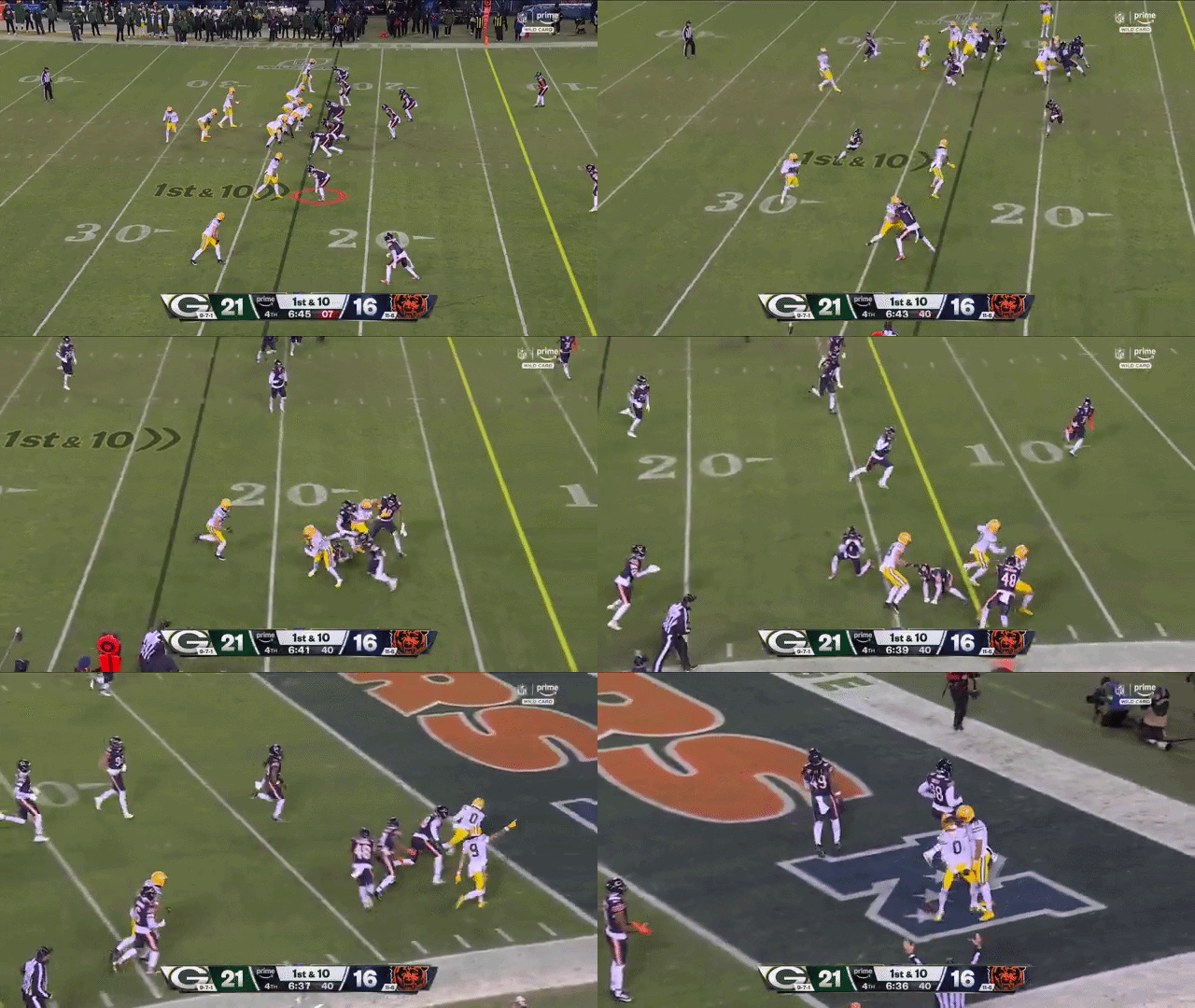
In gotta-have-it situations, LaFleur called plays for Golden in the Dallas game and the playoff game. Against the Cincinnati Bengals, Love trusted him on a second-reaction play for the dagger. And on what could have been the clinching drive in the playoffs against the Bears, the Packers went to Golden multiple times, including a 3rd-and-16 conversion in which Love changed Golden’s route and hit him on a deep out for a first down.
And that’s before we account for what looked like the game-clinching touchdown on one of the best individual plays anyone made for the Packers all season in that Bears game.
Ask the fans, and they’ll tell you the Packers upgraded by letting Doubs walk if it means Golden’s target share doubles. And they might be right.
Speaking of upgrades, Zaire Franklin comes in to replace Quay Walker, thanks to a trade for Colby Wooden. Walker struggled to find a home for the Packers despite multiple coaches, schemes, and positions. To hear him tell it, Green Bay never used him correctly. The tape tells a different story: he was never a consistent or impactful player.
Franklin may be coming off his worst season as a pro, but two years ago, he was one of the most productive and impactful linebackers in the NFL, and he hasn’t lost much, if anything, athletically.
And though Nate Hobbs entered training camp as the starter, that’s a job he ultimately lost to Carrington Valentine. The Packers cut him to avoid paying him over $6 million in a roster bonus and replaced him with ex-Los Angeles Chargers cornerback Benjamin St-Juste, a taller, lanky corner who will tackle and play special teams at the very least.
Either St-Juste pushes Valentine for that starting job, or he replaces Hobbs as the third boundary cornerback on the team. Either way, the Packers were willing to eat considerable dead money to move on from Hobbs, albeit with a post-June 1 designation to spread the dead cap hit out, which tells us they did not think much of him as an outside player.
That, too, looks like an upgrade for where the Packers needed depth.
Key additions come at positions of need
PB: Javon Hargrave replaces Wooden in the defensive line rotation and immediately has a case as the best defensive lineman on the roster. Though he’s a negative in the run to the point he got benched in Minnesota, Hargrave remains one of the best interior pass rushers in the NFL.
He may be duplicative with Devonte Wyatt as a one-gap penetrator, but he’s better than Wyatt, knows Jonathan Gannon’s scheme, and offers an immediate upgrade over Karl Brooks or Wooden.
The Packers still desperately need some run defense with a true nose tackle, but some worthy players linger in free agency (D.J. Reader, come on down), and it’s a very deep defensive tackle class.
Meanwhile, Skyy Moore comes in as the first true returner the Packers have added since what feels like Desmond Howard. He broke multiple long returns for the San Francisco 49ers last year and clearly improves on the play Green Bay got from Savion Williams on kickoffs and Romeo Doubs on punts.
Overall, the depth got worse for the Packers because they’re elevating players who were already on the roster, but there’s a straightforward case that those players can be better and more impactful for Green Bay in 2026 than the outgoing players were in 2025.
Add in the players Gutekunst brought in, and this roster, at least with its starters, projects to be even better for this fall.
QB2 question lurks as crucial for 2026
PB: Malik Willis heads to Green Bay South, leaving the Packers with a gaping hole behind Jordan Love. Willis showed each of the last two seasons how valuable LaFleur can make a backup quarterback with Willis’ skillset in this offense. That’s not to say he could do that with every quarterback. Clayton Tune proved there are limits, even to offensive genius.
According to ESPN, the Packers are one of the teams to watch in the Anthony Richardson trade market, a similar swing to the Willis trade 18 months ago. Despite losing his job to Daniel Jones last season, Richardson has shown more in his brief NFL career than Willis ever had. In terms of pure arm talent, he might legitimately be peerless in the NFL in terms of the high-level throws he’s capable of making from muddy pockets.
And with his combination of size and athleticism, his running ability mimics what the Packers were able to weaponize with Willis. But the same consistency issues dog Richardson that plagued Willis in Tennessee. If LaFleur can clean up his footwork and accuracy, Green Bay could legitimately upgrade, at least on pure talent, from one of the best backups in the NFL last season.
It all depends on cost. If Gutekunst could trade Richardson for a Day 3 pick, even a fourth-rounder, the Packers could rehab his value enough to get that pick back or more with a comp pick in free agency, and he’d cost less than signing a player on the open market.