

Packers post-June 1 preview
June 1 has arrived. That date holds significance for the Packers and the rest of the NFL, as certain players will soon shake loose from their current teams.

Before we begin today’s newsletter, we’d like to comment on a major change affecting everyone on the internet: Google’s transition away from the “10 blue links” search format.
This decision has garnered considerable attention, as does seemingly every attempt by tech companies to impose AI on people. This move has the potential to have a greater impact on web publishers like us at The Leap than the previous, mistake-riddled AI incursions. Google has determined that the best path forward involves effectively preventing users from encountering a webpage owned by another company, all while siphoning off the content from those pages without providing any compensation.
This has tremendous ramifications for not just those of us who make a living by producing content on the internet, but you as a reader. For the better part of the past two decades, Google provided traffic to websites in exchange for listing them on its searches, an exchange that benefited both sides. Still, that deal tilted heavily toward Google, with the company taking such a controlling grip on search and search advertising that it eventually landed in court on antitrust grounds. In that case, the court found Google maintained an unlawful monopoly.
That loss didn’t curtail Google’s efforts to hurt the rest of the internet ecosystem. Its latest move will virtually guarantee that referral traffic will reach near zero for the very sites from which it steals information. If Google succeeds, many of the places you frequent on the internet will disappear, as they will not have the means to sustain themselves. And no matter how “advanced” the chatbots become, they can only regurgitate what they take from outside sources. When those sources leave for good, those seeking reliable information will find themselves left in the dark.
This scenario seemed possible if not probable when Peter and I first discussed launching The Leap back in 2021. Accordingly, we designed our approach so that we didn’t need to rely on Google the way so many other publishers do. Indeed, very little of our traffic now comes from search engines. We have instead built our audience by word of mouth and winning subscribers one at a time.
That means we succeed only because you -- yes, literally you, the person reading this right now -- chose to spend a portion of your day reading The Leap. It also means that we need your support now more than ever. If you value the thoughtful, original, independent coverage of the Green Bay Packers that we’ve delivered for years, please consider a paid subscription. Your support goes directly to Peter and me and allows us to continue pushing The Leap forward.
If you already have a paid subscription -- and THANK YOU if so! -- please help spread the word by sharing this story with someone you believe will enjoy it. If you feel particularly generous, you can even gift a subscription.
Peter and I cannot thank you enough for helping build The Leap into an important place for Packers coverage. At a time when so many of our contemporaries have faded away, we continue to grow, and that only happens because of the support of this community.
With that, let’s dive into today’s edition of The Leap, which previews the post-June 1 action that will arrive later this week.
Thank you for reading and supporting our coverage. You can also support our work by following us on social media:
Jason B. Hirschhorn: @by_JBH on Twitter / @byjbh@bsky.social on Bluesky / @by_jbh on Threads
Peter Bukowski: @Peter_Bukowski on Twitter / @peterbukowski@bsky.social on Bluesky / @peter_bukowski on Threads
The Leap: @TheLeapGB on Twitter / @theleap.bsky.social on Bluesky / The Leap's YouTube channel
As always, thanks for making The Leap a part of your day.
Post-June 1 preview
Jason B. Hirschhorn: Before diving into the potential moves that could come after June 1, let’s briefly dive into why this date matters in the NFL calendar.
In the most basic terms, the league’s salary-cap rules make an accounting distinction between players released earlier in the offseason without a June 1 designation and those moved after that date or designated as post-June 1 cuts. A team releasing a player with multiple seasons left on his deal will accelerate all of the dead money -- funds already paid but prorated over future years for cap purposes -- into the current year if making that move before June 1 (and without a designation). Conversely, if that same player receives a June 1 designation or the team waits until that date to process the release, that dead money will instead apply to next year’s books.
Green Bay recently did this with Nate Hobbs. When he originally arrived in 2025, he received a $16 million signing bonus, which the team spread evenly over the four years of his contract. That meant the Packers had to deal with $12 million in prorated bonus money when releasing Hobbs earlier this offseason. Because they designated him as a post-June 1 cut, they will only take $4 million in dead money for him in 2026. The other $8 million will hit their books in 2027.
A June 1 designation also includes an important stipulation: The team in question must carry the player’s original contract on its books until after that date has passed. Accordingly, the Packers will officially see Hobbs’ cap number move off their 2026 books this week, netting roughly $8.8 million in cap space as a result.
The Packers could utilize that additional cap space in a variety of ways. At least some of it will likely go toward extending one or more of their veteran players with expiring contracts. That group includes Tucker Kraft and Christian Watson, two of the offense’s most important players. Kraft could plausibly land a new deal that resets the tight-end market (currently paced by George Kittle’s four-year, $76.4 million extension signed in 2025). Watson’s financial outlook might parallel that of Alec Pierce, who signed a four-year, $114 million pact in March.
Kraft continues to work his way back from last season’s ACL tear, though both general manager Brian Gutekunst and head coach Matt LaFleur have expressed optimism that the star tight end will return well in advance of Week 1’s matchup with the Minnesota Vikings. Watson doesn’t have an injury complication, but he cannot officially sign a new deal with Green Bay until 12 months have passed since the one-year extension he inked last September. Still, the receiver and the team can negotiate the terms before then.
Of course, the Packers will monitor post-June 1 developments occurring elsewhere. A report from Jordan Schultz made a thinly veiled reference to the team’s interest in Josh Sweat, the Arizona Cardinals pass rusher who played for new Green Bay defensive coordinator Jonathan Gannon in multiple locations. Sweat recorded a career-best 12 sacks in 2025, but he enters his age-29 season and might have a degenerative knee issue stemming from an injury he suffered in high school. As a result, the Cardinals might not demand more than a mid-round pick for his services.
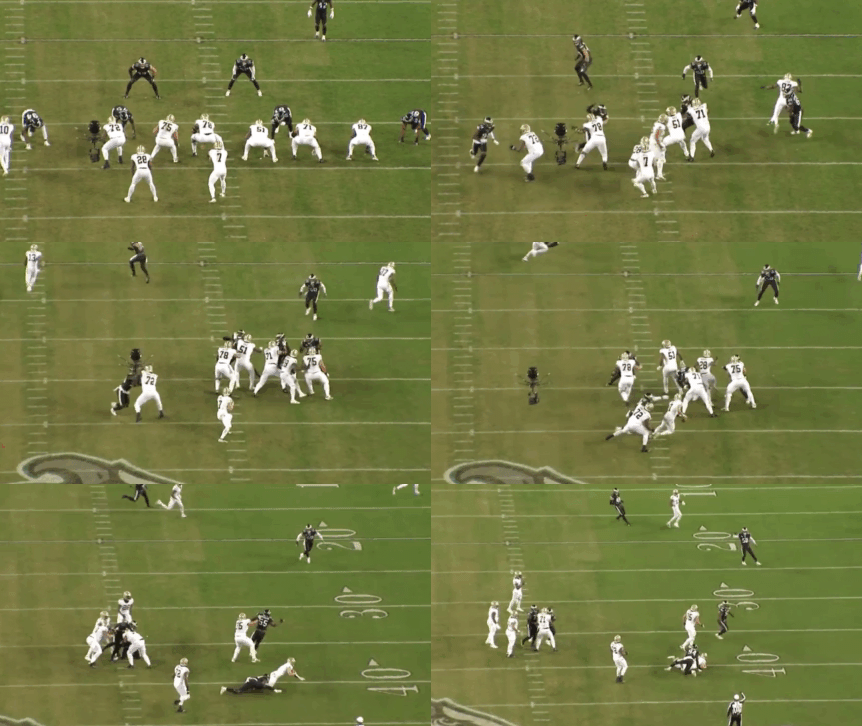
Another well-known veteran has seen his name connected to the Packers as a potential post-June 1 target. Alvin Kamara, the veteran running back who has spent his entire career with the New Orleans Saints, might no longer factor into his team’s plans. The Saints considered moving him before last season’s trade deadline, but Kamara reportedly told general manager Mickey Loomis that he preferred to remain with the franchise for the remainder of his career.
Perhaps Kamara still prefers to stay in New Orleans. However, he expressed those sentiments before the team signed Travis Etienne to a four-year, $47 million contract to essentially take his role in the offense. If that move has forced Kamara to reconsider his NFL future, a market should exist for his services.
With Kamara, June 1 matters more for the Saints than a team interested in acquiring him. Once that date passes, the dead money that would hit New Orleans’ books in 2026 drops from roughly $21.4 million to a hair over $7 million, a tremendous difference for a club that has just over $8 million in cap space as of this writing, according to Over the Cap.
Whether the Packers make sense as a suitor for Kamara remains entirely unclear. The notion first arose in the direct aftermath of Josh Jacobs’ arrest on domestic-abuse allegations last week. While the Brown County district attorney opted against filing charges, the investigation into Jacobs will continue. Accordingly, he could still face charges at some point in the future. Even if he doesn’t, the NFL could still suspend him.
If the Packers ultimately determine that they’ll need to make other arrangements at running back, Kamara offers a mixed bag as a possible replacement. A telling underlying metric like rush attempts per broken tackle show that he actually performed better over the past two seasons (17.5 and 18.7) than he did from 2022 to 2023 (31.9 and 25.7). At the same time, Kamara averaged a career-worst 1.4 yards after contact -- the yards not blocked by the offensive line that the ball carrier produced -- this past year.
Kamara has never served as a bell cow, and that won’t change in his age-31 season. Still, he would offer experience to a backfield that, sans-Jacobs, would feature MarShawn Lloyd, Chris Brooks, and a handful of other guys who combine for less than 100 career carries in the NFL. Kamara can also factor into the passing game, providing utility that not even Jacobs offers.
Elsewhere, a notable linebacker might shake loose from his current team. Patrick Queen, the former second-team All-Pro, enters the final season of his three-year, $41 million contract with the Pittsburgh Steelers. Given the organization’s regime change this offseason -- longtime head coach Mike Tomlin resigned, with Mike McCarthy replacing him -- Queen’s future in Pittsburgh hangs in the balance.
“I saw the whole charade that went on all this offseason, but I mean, it’s talks,” Queen told the Pittsburgh media this past week of the negotiations between his representatives and the Steelers. “Obviously, no movement either way.
“So, at the end of the day, they have business to handle. I’ve got business handled at home, and my business is to go out there and play the best football I can and put myself in a good position and put our team in a good position so that we both get successful.”
Though the Packers might have had interest in adding Queen at an earlier point in the offseason, they addressed the position by trading for Indianapolis Colts linebacker Zaire Franklin. Still, Queen could plausibly land in the NFC North. Chicago Bears senior defensive assistant Bill Johnson worked on the LSU coaching staff when Queen played in Baton Rouge. The Detroit Lions have multiple staffers with ties to LSU, including two who coached during Queen’s time there (Caleb Collins and August Mangin). Minnesota Vikings assistant Gerald Alexander served on the Steelers’ staff last season, giving him personal familiarity with Queen.
Another name worth monitoring currently plays for the Cleveland Browns: Denzel Ward
Though Ward has not surfaced as a trade candidate, that could change if/when the Browns make Myles Garrett available. They have resisted those calls since Garrett publicly demanded a trade early in the 2025 offseason, instead signing the future Hall of Famer to a record-setting contract. Still, with the team making a change at head coach this offseason and in need of a personnel reset, trading the soon-to-be 31-year-old Garrett might provide a path to the next contending version of the roster.
Should the Browns trade Garrett -- and waiting until after June 1 would turn a net loss of about $17.2 million in 2026 into a cap savings of over $8.3 million -- they would have little reason to keep Ward. While not as old as Garrett, Ward turned 29 earlier this year, nearly geriatric by cornerback standards. He will almost certainly not remain a key piece of the Cleveland defense by the time a post-Garrett roster has a shot to make noise.
The Packers have already made a big bet on a cornerback this offseason, drafting South Carolina’s Brandon Cisse in the second round. Still, a corner of Ward’s caliber would at least necessitate a discussion at 1265 Lombardi Ave. And even if Gutekunst decides he can’t justify the cost, that doesn’t mean Ward couldn’t land elsewhere in the NFC.