

What last year's left-tackle discourse suggests about the 2026 Packers
Brian Gutekunst said Jordan Morgan "probably did enough" to start over Rasheed Walker in 2025. The choice to start Walker anyway reveals some things about the offense.

Good morning!
After weeks of drips and drabs, the NFL finally released the full 2026 regular-season schedule. The Green Bay Packers finally know the order of their opponents, a slate that head coach Matt LaFleur called “probably the most unique schedule in regard to how many days you have off in between games that we’ve ever seen.”
With the dusk mostly settled on the schedule front, today’s edition of The Leap takes a look back at an important conversation from this time last year that informs how to view the 2026 Packers.
Thank you for reading and supporting our coverage. You can also support our work by following us on social media:
Jason B. Hirschhorn: @by_JBH on Twitter / @byjbh@bsky.social on Bluesky / @by_jbh on Threads
Peter Bukowski: @Peter_Bukowski on Twitter / @peterbukowski@bsky.social on Bluesky / @peter_bukowski on Threads
The Leap: @TheLeapGB on Twitter / @theleap.bsky.social on Bluesky / The Leap's YouTube channel
If you appreciate thoughtful, independent coverage of the Packers and NFL, please consider becoming a paid subscriber. Your support allows us to serve this community with the stories and reporting it deserves.
As always, thanks for making The Leap a part of your day.
What does last year’s discourse around the Packers’ left-tackle competition reveal about their offensive line in 2026?
Jason B. Hirschhorn: Barring an injury or some other unforeseeable development, the Packers will enter Week 1 with Jordan Morgan as their starting left tackle. This comes after Rasheed Walker, the team’s starter in that spot for the past three seasons, departed in free agency.
That Morgan has emerged as Green Bay’s primary blindside protector doesn’t seem surprising now, but that outcome hardly looked assured at this time last year. Back then, Walker had just completed his best season to date, while Morgan managed just one start during an injury-shortened rookie campaign. Still, the team’s decision-makers declared the job open for competition.
The Leap wrote extensively about the situation last May:
From the outset of the 2025 offseason, the Packers expressed an interest in allowing 2024 first-round pick Jordan Morgan to compete with Rasheed Walker at left tackle. General manager Brian Gutekunst, head coach Matt LaFleur, and other members of the staff have shared similar thoughts on the matter, and nothing that transpired during free agency or the draft has undercut that notion.
The rationale behind such a competition seems clear. Walker has provided solid play over two seasons as the starter. But the team seems to believe Morgan either could perform better or push Walker to a higher level, and the offense would benefit in either scenario. Additionally, Walker enters the final year of his rookie contract while Morgan remains under cost control through the 2028 season.
However, despite the Packers’ public position on the left-tackle competition, not many beat writers or national reporters seem to believe Walker won’t ultimately start. The Athletic’s Matt Schneidman continues to mention right guard as a potential role for Morgan. The Athletic Football Show also recently discussed Green Bay’s offseason at length and likewise landed on the idea that Morgan would factor in at guard rather than protecting the blindside.
Does that mean Morgan won’t truly compete at left tackle? Not necessarily, but the disconnect between what those covering the team say and what the Packers state publicly seems notable. When Green Bay says something that the reporting doesn’t mirror, that should always raise alarms. Reporters frequently know details on background that they cannot straightforwardly reveal, but they’ll hint at that knowledge by framing statements as opinions. The Walker-Morgan discourse could well prove to be such a situation.
That last part looks most notable in retrospect. While Morgan did not ultimately take the job, general manager Brian Gutekunst said that he outplayed Walker during the competition.
“I thought he played really well in the preseason at that spot,” Gutekunst said of Morgan during his season-closing press conference. “He probably did enough to win that job, but then we had some injuries, and we had to do what was best for the team.”
Keep in mind that those statements came before Walker left in free agency. Given the contract he signed with the Carolina Panthers -- a base one-year, $4 million deal that can max out at $10 million with incentives -- the Packers could have conceivably retained Walker if they felt uncomfortable letting Morgan take the job. Instead, they’ll roll with a former first-rounder who has just 51 career snaps at left tackle.
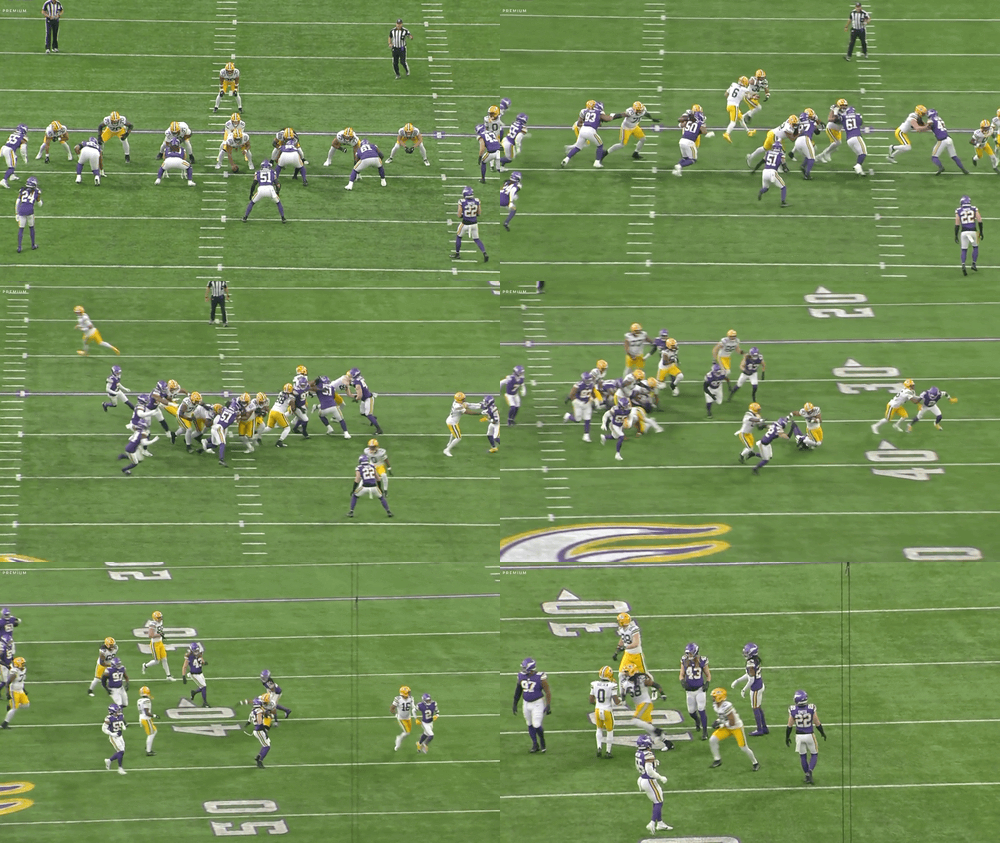
To at least some extent, the Packers’ stated preference for Morgan at tackle and their decision to instead play him along the interior last season combine to reveal what the team believes about its offensive line, both in 2025 and now.
Most straightforwardly, Green Bay’s coaching staff felt better about Walker at left tackle than any of its backups behind Aaron Banks, the left guard who battled injuries in training camp and throughout the season. That might not seem noteworthy at first glance, but consider those other backup options. Darian Kinnard, the multi-positional veteran, could have stepped in at guard and allowed Morgan to handle the blindside. Anthony Belton, the second-rounder who became a starting guard in Week 13 despite few reps inside, could have plausibly begun his transition from tackle earlier.
Perhaps the coaches didn’t like the idea of playing Kinnard at left guard -- he played roughly 97% of his offensive snaps on the right side to that point in his career -- and didn’t want to ask Belton, a rookie, to make a position change without more notice. Even so, the Packers had other options they could have considered. Elgton Jenkins, the starting center when the season began, had spent most of his NFL career at left guard and could have returned to that spot if needed. That would have allowed Sean Rhyan, who began practicing at center in previous years, to move over the ball and allow Kinnard to remain on the right side.
That the Packers didn’t opt for one of those alternative configurations while Banks worked his way back from injuries underscores the concerns about Rhyan at center and, at least in 2025, Belton at guard. Rhyan did eventually make the move after Jenkins’ lower-leg fracture, and though he provided capable play as a run blocker, his pass protection suffered overall. Belton graded as one of the worst starting guards in football, though the lack of preparation for the switch and his minimal NFL experience surely played a factor.
Entering 2026, the Packers have made significant bets on both Rhyan and Belton to improve considerably. History suggests that Belton, now a second-year player who finally has a full offseason to rep at guard, has the better shot of the two at dramatic improvement. Rhyan also will have his summer tailored to center, but those dynamics don’t apply in the same way. He enters his fifth season in the NFL and has already spent time working at his current position before making the full-time switch.
Regardless, the Packers don’t have an obvious Plan B if either one fails to hit their goals. Kinnard returns as the team’s most experienced backup, and both Rhyan and Belton played ahead of him last year. Rookie Jager Burton offers promise, but asking a fifth-round pick to contribute in Year 1 will always present a challenge. The situation looks dicey even if Morgan establishes himself as a starting-caliber left tackle, not a guaranteed outcome either.
If the Packers have an ace up their sleeve, it comes in the form of their quarterback. Jordan Love just delivered his best season to date behind last year’s shaky offensive line and rarely turns pressure into sacks. Entering 2026, he boasts a 4.27% sack rate, the lowest such mark among qualified active players. Those skills will come in handy if Rhyan and/or Belton continue to struggle in pass protection.
Of course, Love can’t fix everything by himself. The Packers can scheme around one inconsistent starter along the offensive line, but if that number grows to two or more, then the passing game could run into some big problems that don’t have obvious in-season solutions.
not to mention we ran back the coordinators, so more of the same, hopefully with better health.