

Hunting for Hasselbecks: Why the Packers draft late-round QBs and who they will target in 2026, Pt. 1
The Packers used to regularly draft QBs in the late rounds, uncovering gems like Matt Hasselbeck and flipping them in trades. GM Brian Gutekunst wants to revive that practice.

To some, the most pragmatic approach to the quarterback position comes from Tom Moore, a longtime NFL assistant who served as Peyton Manning’s offensive coordinator for the majority of his career. With Manning under center, Moore helped design some of the most dominant offenses in league history. However, most know the coach mostly for his now-famous quip about why the Indianapolis Colts rarely gave reps to Manning’s backup during practice.
“Fellas, if ‘18’ goes down, we’re f--ked. And we don’t practice f--ked,” Moore said.
But while Moore thought of quarterback situations as a binary -- all good or totally “f--ked” -- this approach ignores other scenarios. What if the starter goes down for only a handful of weeks and the season pivots on the games he misses?
The Green Bay Packers have seen the benefits of a quality backup QB over the past two years. In 2024, Malik Willis started two games and played a sizable chunk of a third in relief of Jordan Love, helping the team emerge victorious in all three. Had the Packers lost more than one of those contests, they would not have qualified for the playoffs that season. Willis again performed well with Love sidelined in 2025, putting Green Bay in position to win against the Chicago Bears in a division-tilting matchup.
All of which underscores an important lesson: A backup quarterback might not replicate the play of the starter, but he can still prove the difference between his team making the tournament and watching the postseason from the couch. Front offices can acquire those players in a variety of ways, but the NFL draft provides the most cost-effective method.
Packers general manager Brian Gutekunst hasn’t hidden his interest in regularly drafting quarterbacks in the late rounds. At the 2024 NFL Scouting Combine, he dropped a not-so-subtle hint about his team-building plans.
“Getting back to drafting multiple quarterbacks is something that I’ve wanted to do,” Gutekunst said. “We kind of went away from that for a few years. I’d like to get back to that, because I just think having young, talented quarterbacks on your roster that the coaches can develop, I just think is really healthy and important for a franchise.”
Over the last three decades and change, most have thought of the Packers as the NFL team that always has a franchise quarterback. Shortly after Ron Wolf took over as GM in November 1991, he traded a first-round pick for Brett Favre, a second-year signal-caller who saw little action as a rookie. That move planted the seeds for a long stretch of title contention that Aaron Rodgers, Favre’s eventual successor, would later extend into the 2020s before passing the baton to Love.
But as Wolf kicked off Green Bay’s unparalleled streak of top-shelf passers, he also built a QB factory behind it. Starting with his first draft as the team’s GM, Wolf made a habit of taking a signal-caller outside the top 100 picks, doing so nearly every year for the remainder of the decade. Some of those selections never played a down, but others delivered much, much more. Ty Detmer lasted 14 seasons as a high-end backup. Aaron Brooks became a preferred starter for half a decade. Two others, Mark Brunell and Matt Hasselbeck, developed into Pro Bowlers and true franchise players.
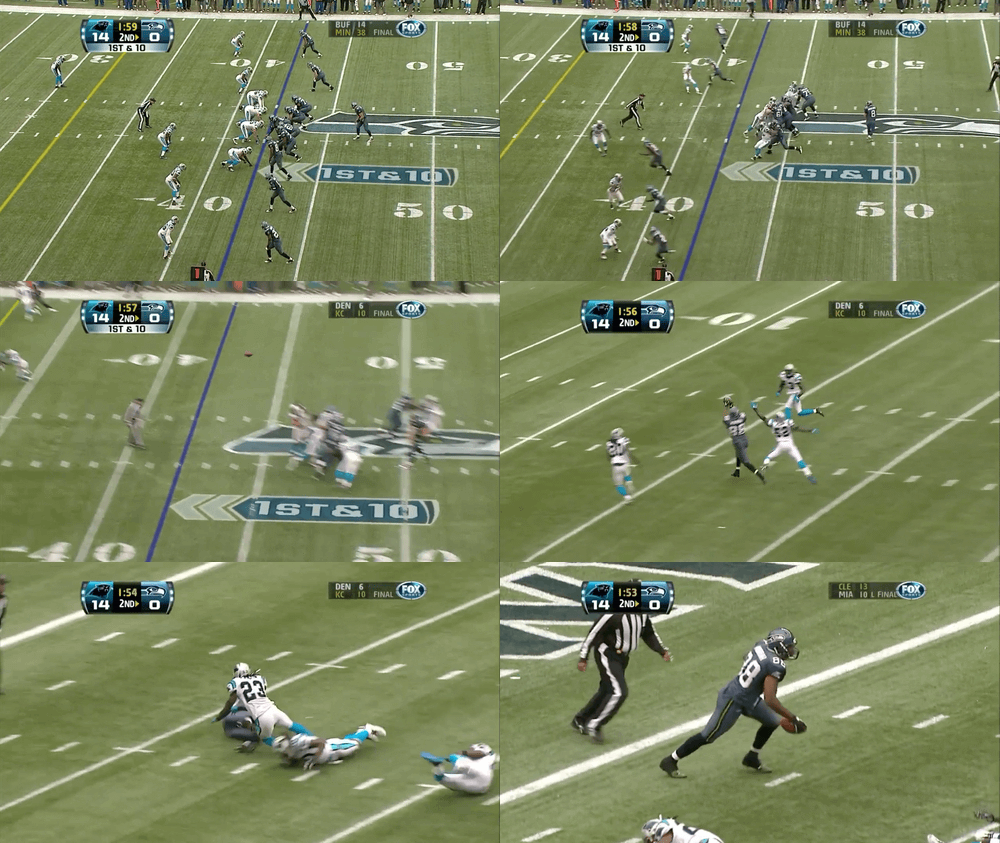
Just as importantly, the Packers flipped many of those quarterbacks in trades. Wolf turned Brunell, originally a fifth-rounder, into picks in the third and fifth rounds. Brooks formed the crux of a trade package that netted a third-rounder and a reserve linebacker. Hasselbeck returned even more, earning Green Bay a third-rounder and allowing the team to jump from the 17th overall pick to No. 10 in the 2001 draft. All that bonus draft capital helped keep the franchise competitive during Wolf’s tenure and beyond.
And those bounties resonated with others in Green Bay’s front office. The Packers continued to take late-round swings on quarterbacks when Ted Thompson, a former Wolf deputy, took over as general manager. While Thompson didn’t do so as frequently as his mentor, he went on to draft four signal-callers outside the top 100, turning multiple of them into future draft picks via trade or the compensatory-pick system.
And Gutekunst now finds himself well positioned to receive a valuable asset for his bet on Willis. The former backup just signed a three-year, $67.5 million deal with the Miami Dolphins to take the reins under center. While the Packers won’t learn what kind of compensatory pick they’ll receive for Willis until next year, they could ultimately net an extra draft choice in the fourth or third round. That would mark a significant return on investment for a player who originally cost Green Bay a seventh-round selection.
Gutekunst has largely maintained the draft guidelines of the other general managers in his lineage, especially Thompson’s principles. Accordingly, those late-round quarterback selections can provide a window into which prospects the Packers might actually consider this April should they choose to take one.
The 2024 edition of this series correctly identified Michael Pratt as a future Green Bay pick. The Leap’s model also underscored Clayton Tune, who spent most of 2025 on the team’s practice squad. While neither of those players ultimately worked out, the model did spotlight Tyson Bagent, Tanner McKee, and Joe Milton, quarterbacks who have emerged as high-quality backups and potential future starters. Additionally, 2025’s installment featured three quarterbacks not drafted in the first three rounds who combined for seven starts as rookies.
All of which sets the stage for 2026. With Willis gone, the Packers need a new backup for Love. While Gutekunst could find one in the veteran market, those options come with complications.
The notion of trading for Colts quarterback Anthony Richardson has gained traction in recent weeks, with ESPN’s Stephen Holder reporting that the Packers have interest in the former No. 4 overall pick. Like Willis, Richardson offers robust athleticism and arm talent that his first NFL team couldn’t mold into a quality starter. Many of the tactics that Green Bay used with Willis could theoretically work with Richardson as well.
However, the two situations differ in key ways.
During Willis’ first two years in the NFL, he played for a head coach who did not want to draft him (Mike Vrabel). Willis then spent the 2024 training camp and preseason under a new head coach who failed so spectacularly that the Tennessee Titans fired him less than two seasons into his tenure. All the while, the supporting cast created artificial hurdles for the team’s other signal-callers. As such, Willis’ lack of progress during that time says as much about Tennessee as it does Green Bay.
That stands in stark contrast with Richardson’s circumstances in Indianapolis. The Colts provided quality weapons around the quarterback (Jonathan Taylor, Alec Pierce, and Michael Pittman Jr.) and had a proven difference-maker serving as head coach and offensive play-caller (Shane Steichen). That same support system allowed journeyman Daniel Jones to put up MVP-like numbers. However, Richardson managed to complete just over 50% of his passes while tossing more interceptions (13) than touchdowns (11) over 17 games.
Perhaps Gutekunst sees Richardson as salvageable. But even then, he would count more against the Packers’ salary cap in 2026 than Willis did over the past two seasons combined, and that cost comes on top of whatever the team would need to trade to the Colts. And unlike Willis, Richardson will functionally have only one season left on his deal at the time of acquisition, as nobody can justify exercising the fifth-year option in his contract worth over $22 million.
While Gutekunst could still plausibly pull the trigger on Richardson or another veteran, the draft remains the most cost-effective way to find a quality signal-caller. Even if the Packers do add a veteran backup, that wouldn’t prevent them from spending a pick on a prospect who could take over the role in 2027 and beyond.
This year’s QB class lacks star power at the top, but it features plenty of intriguing prospects at the position who Green Bay could target in the later rounds. The Leap’s next newsletter will tackle the profile for those players and which of the incoming rookie signal-callers have a chance to land on the Packers’ draft board.
-- Jason B. Hirschhorn is an award-winning sports journalist and Pro Football Writers of America member. Follow him on social media: @by_JBH on Twitter / @byjbh@bsky.social on Bluesky / @by_jbh on Threads